
Dear Friends and Colleagues,
As we reflect on this past year, we affirm the importance of IRP’s mission to produce nonpartisan evidence and research to inform policymaking and practice in areas related to economic hardship, inequality, and social mobility, and their effects in the United States. IRP’s pursuit of this mission is enabled by our key resources—our staff; affiliated faculty, student, and post-graduate scholars; the Wisconsin Administrative Data Core; and our training programs in collaboration with partner organizations like Howard University’s Center on Race and Wealth and UC-Davis’s Center for Poverty and Inequality Research. Local, state, and federal program and policy stakeholders and practitioners must make decisions, with or without available information and evaluation; through our on-going cooperative agreements, we work with our policy and practice partners to ensure such decision-making can be based on timely and robust evidence.
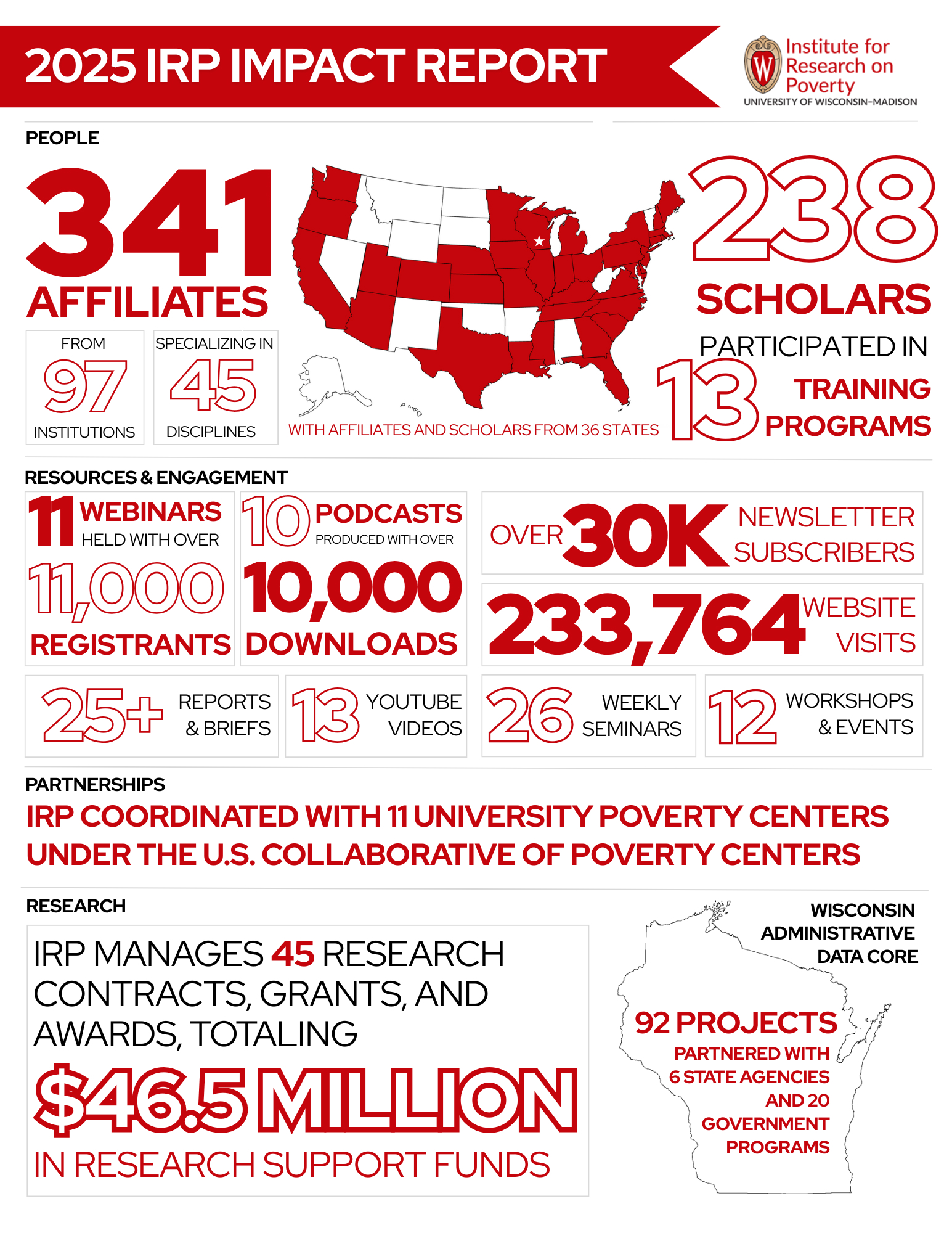
In 2025, some notable milestones stand out. IRP launched several outreach initiatives, including the Wisconsin Poverty Research Network (WPRN) and the Wisconsin Knowledge Boost (WKB), focused on connecting poverty researchers, practitioners, policymakers, and the public across Wisconsin. IRP built our network of research and resource engaged individuals to over thirty thousand, we supported 238 junior scholars in research training, and held widely attended events focused on critical topics, importantly the 2025 Lampman Memorial Lecture with Matthew Desmond. Our 2025 IRP Impact Report highlights many more contributions and efforts achieved over the last year.
In 2026, IRP will reach a milestone of its own: its 60th anniversary! While the human services programs that serve those with economic need have evolved over this period, as has the research infrastructure that we use to understand them, the need for evidence-informed policy and practice is as strong as ever.
We hope you’ll join us in marking IRP’s 60th anniversary. Whether it be by sharing your research, engaging in intellectual community through seminars and webinars, or mentoring emerging scholars, your work makes IRP a better and stronger institution. Your financial contributions also make an important difference as we seek to improve the effectiveness of public policies that reduce poverty and inequality as well as promote economic mobility and to support the next generation of poverty, inequality, and economic mobility scholars. We look forward to working with you in 2026!
All the best,
Sarah Halpern-Meekin
IRP Director